
Tasua and Ashura in Abyaneh
An Ancient Muharram Tradition in Iran
Every year, with the arrival of the Islamic month of Muharram, a very different atmosphere is felt in Iran.
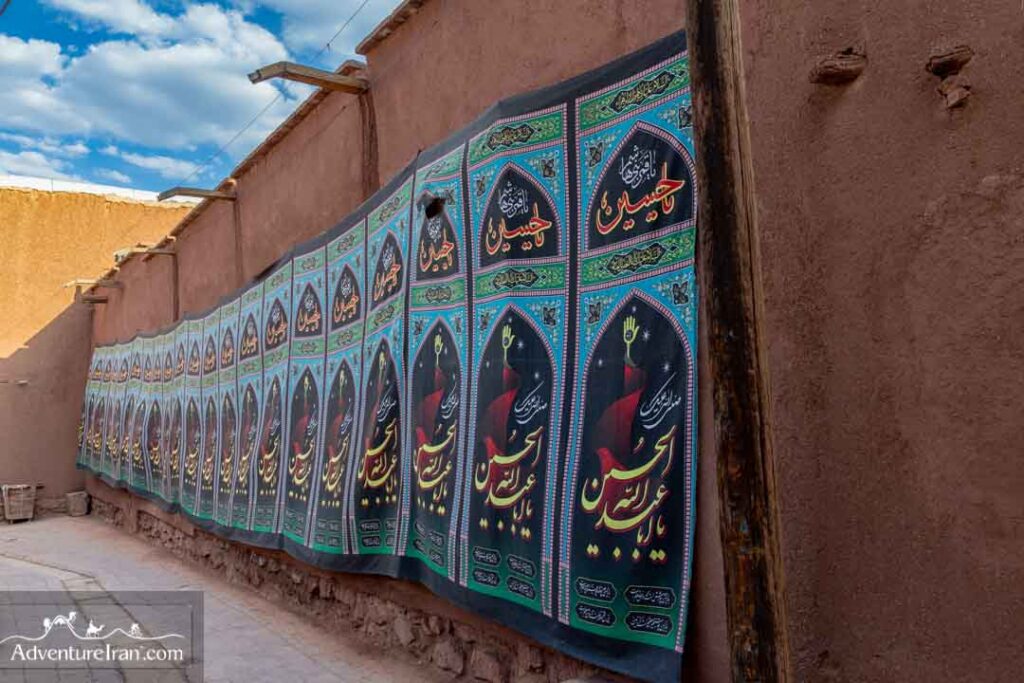
Streets and mosques are decorated, especially with black flags appearing in towns and villages. People gather for mourning ceremonies, prayers, religious speeches, and processions. In many parts of the country, families prepare NAZRI—food and drinks are distributed freely as a religious offering—and communities come together to remember one of the most important and emotional events in Islamic history. Many people prepare free tea and Sharbat, a type of syrup well known in Persian Culture- in the streets and villages.
For Shia Muslims, Muharram is a month of mourning for Imam Hussein, the grandson of the Prophet Muhammad, and his companions, who were killed in the Battle of Karbala in 680 CE. The tenth day of Muharram, known as Ashura, is the central day of mourning. The day before it, Tasua, is also deeply significant, particularly because of its association with Abbas ibn Ali, the half-brother of Imam Hussein and one of the central figures of the Karbala story.
Across Iran, Muharram is observed in many different ways. Some cities are famous for enormous processions, others for Ta’zieh, a traditional form of religious theater, while villages and local communities often preserve their own distinctive rituals. One of the most remarkable places to experience these traditions is the historic mountain village of Abyaneh in central Iran. During Tasua and Ashura, Abyaneh becomes a place of mourning, remembrance, and community. Its narrow red-earth streets fill with traditional ceremonies that have been preserved by generations of villagers.
Among them are Jaghjagheh-zani, Nakhl-gardani, Parsa or Porseh, Shada-gardani, Tolu-khani, and Sham-e Ghariban.
Together, these ceremonies reveal a side of Iranian culture that cannot be understood simply by visiting historical monuments. They are part of a living tradition.
What Is Muharram?
Muharram is the first month of the Islamic lunar calendar and is considered one of the sacred months in Islam. For Shia Muslims, however, Muharram carries an especially deep emotional and religious meaning because it is associated with the tragedy of Karbala. In 680 CE, Imam Hussein refused to recognize the rule of Yazid ibn Muawiya. He and a group of family members and companions traveled toward Kufa, in present-day Iraq. They were eventually stopped by Yazid’s forces at Karbala. On the tenth day of Muharram, Imam Hussein and most of his companions were killed.
The events of Karbala have become one of the central stories of Shia Islam, representing themes of sacrifice, justice, resistance, loyalty, and devotion. For this reason, Muharram is not simply a historical commemoration. For many Shia communities, it is a time of deep personal and collective mourning.
Throughout Iran, the month is marked by mourning gatherings, processions, recitations, religious ceremonies, charitable food distribution, and local traditions that have developed over many generations.

Tasua and Ashura
The ninth and tenth days of Muharram are known as Tasua and Ashura. Tasua is traditionally associated with Abbas ibn Ali, who was the brother and standard-bearer of Imam Hussein. His loyalty and sacrifice during the events of Karbala have given the day a special place in Shia mourning traditions.
Ashura, the tenth day, commemorates the final battle and death of Imam Hussein and his companions. The ceremonies held on these two days vary greatly from one region to another. This regional diversity is one of the fascinating aspects of Muharram in Iran. Although the story being remembered is the same, every community has developed its own ways of expressing grief, devotion, and remembrance.
Abyaneh is one of the places where these local traditions have survived with a particularly strong connection to the village’s history and social structure.
Abyaneh: The Red Village of Iran
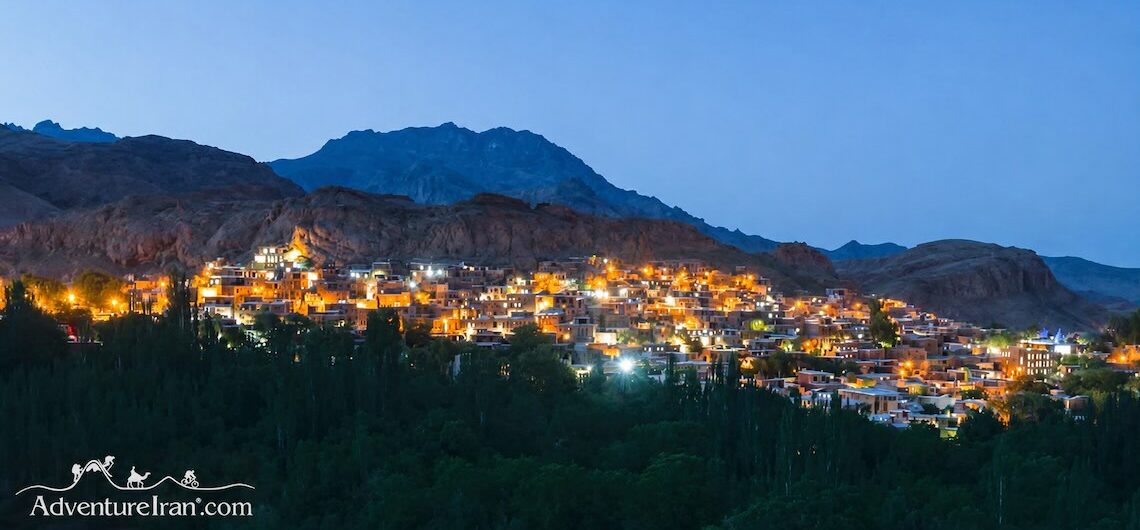
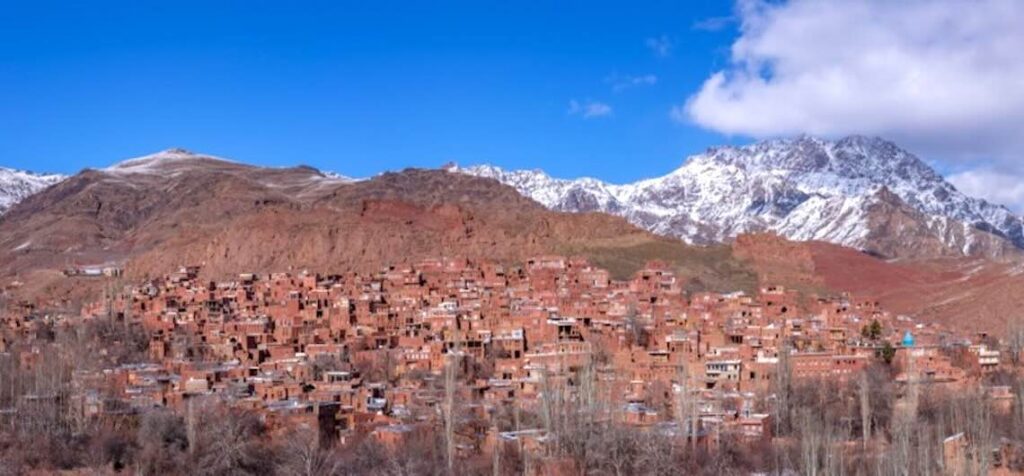
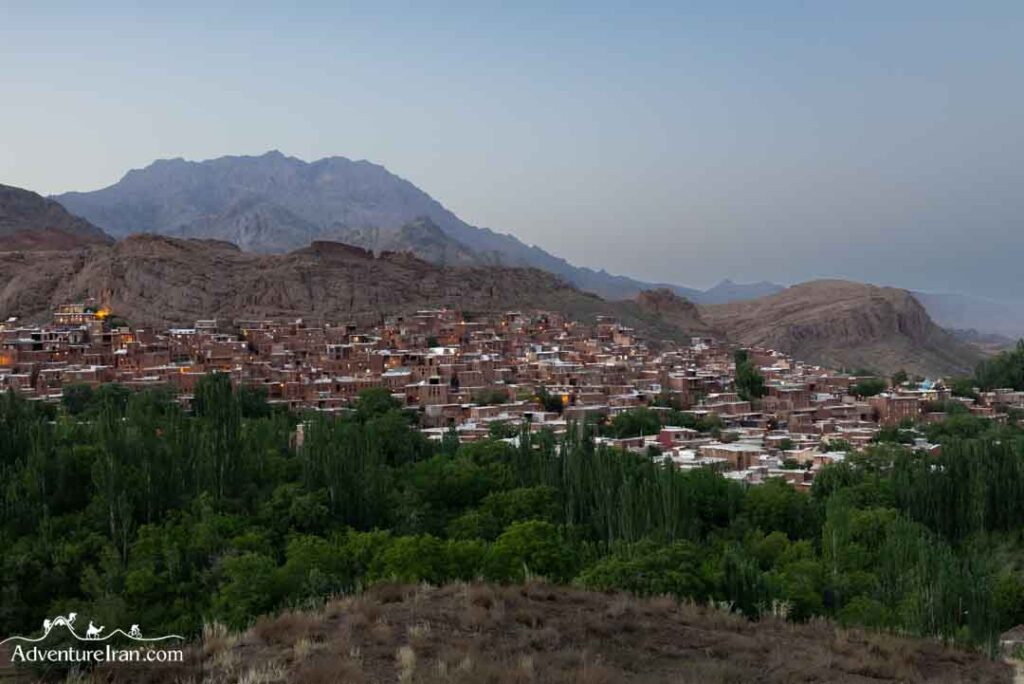
High in the mountains of central Iran, Abyaneh is one of the country’s best-known historic villages. Located in Isfahan Province near Natanz and the Karkas Mountains, Abyaneh is famous for its reddish earthen houses, narrow stepped streets, traditional clothing, and distinctive local culture.
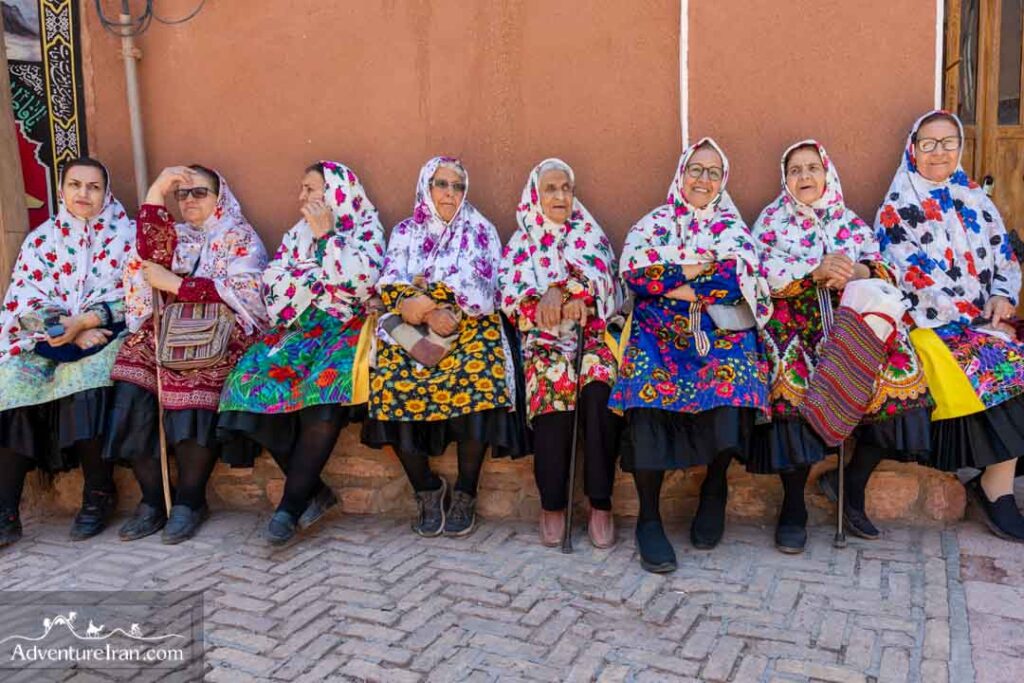
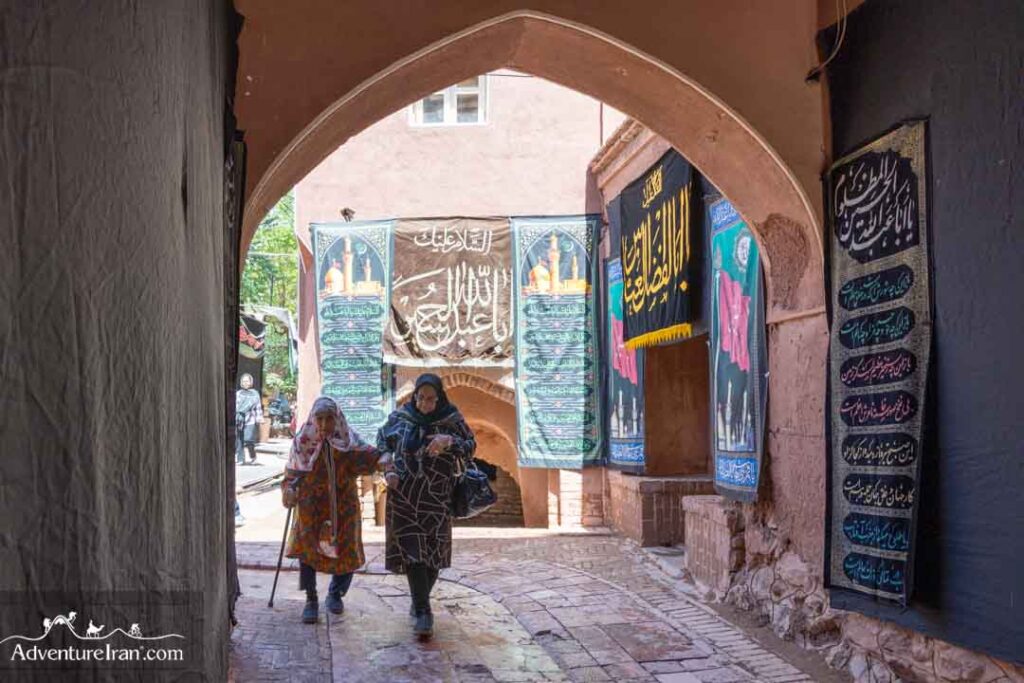
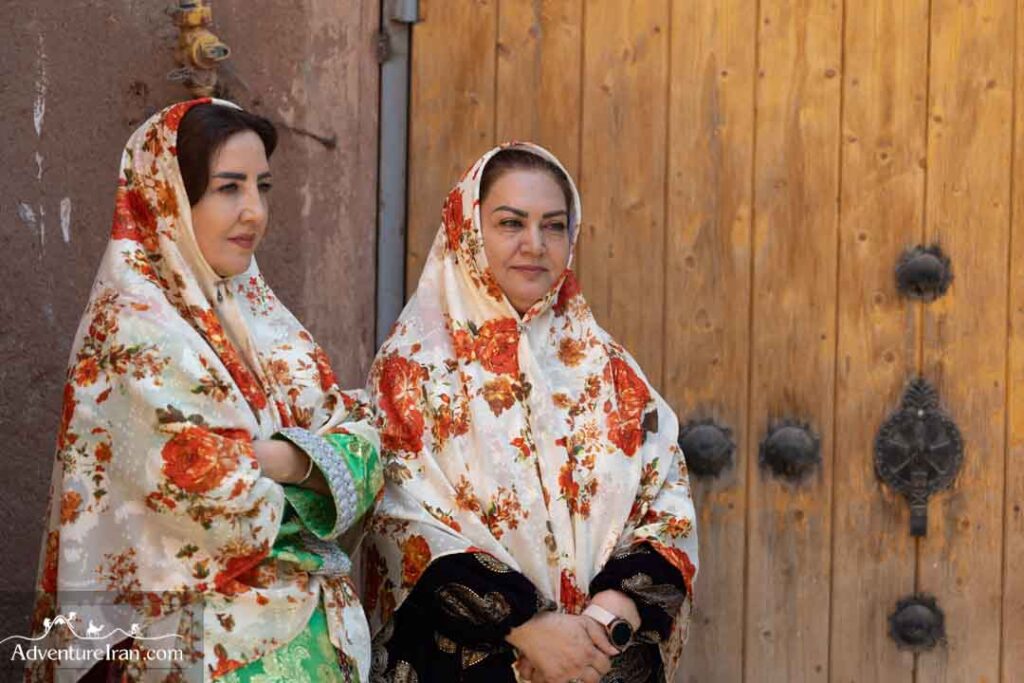
The village was built on the mountain slopes, with houses rising one above another. The reddish color of the walls has given Abyaneh its popular name: the Red Village. But Abyaneh is much more than an architectural attraction. Its traditional clothing, local language, customs, neighborhood structure, and religious ceremonies have helped preserve a strong sense of identity.
UNESCO has recognized Abyaneh as an important cultural heritage site because of the preservation of many of these traditional characteristics. During Muharram, this cultural identity becomes particularly visible.
The village’s historic streets become the setting for ceremonies in which religion, family, memory, and community come together.
Tasua in Abyaneh
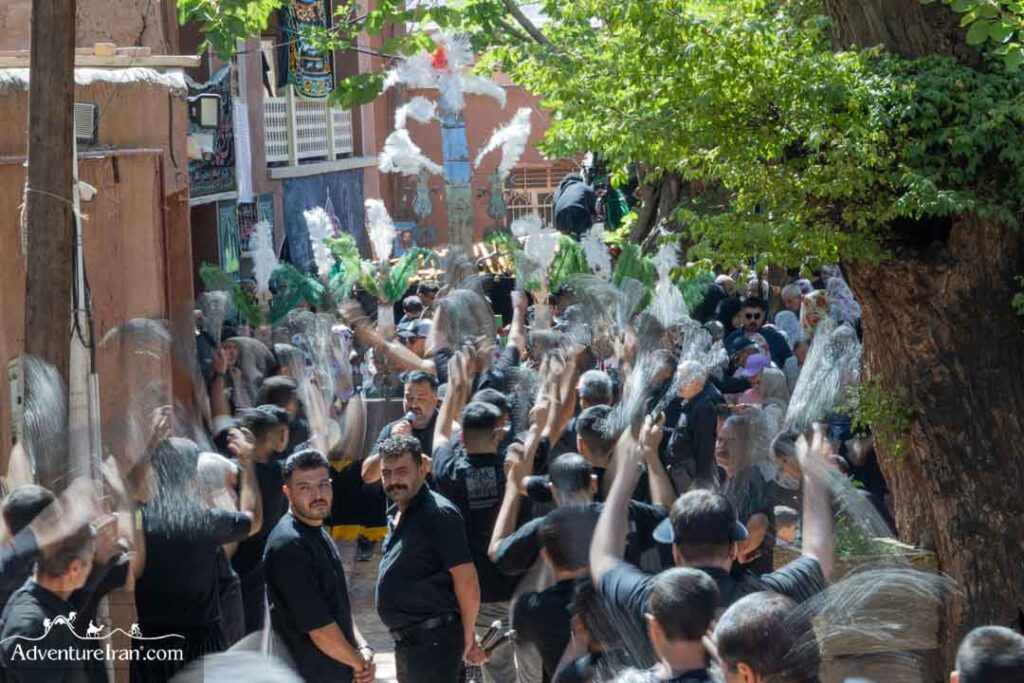
The ceremonies of Muharram in Abyaneh begin before Ashura, with important events taking place on Tasua. Among the best-known traditions are Jaghjagheh-zani, Nakhl-gardani, Parsa or Porseh, and Shada-gardani. Each ritual has its own character, but together they create one of the most distinctive Muharram traditions in Iran.
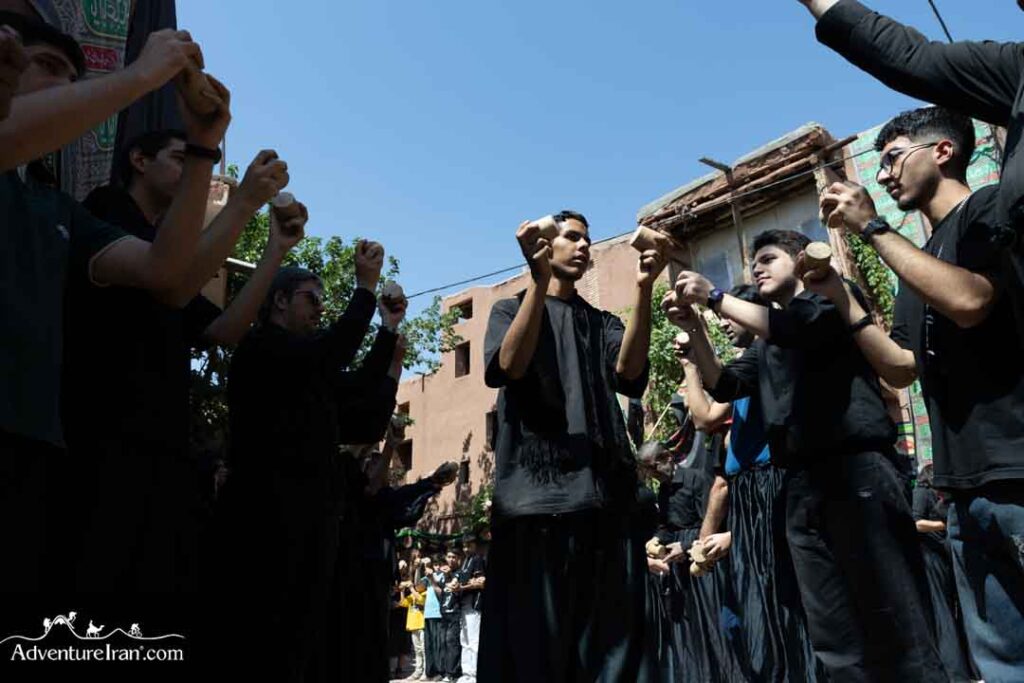
Jaghjagheh-Zani: The Sound of Mourning
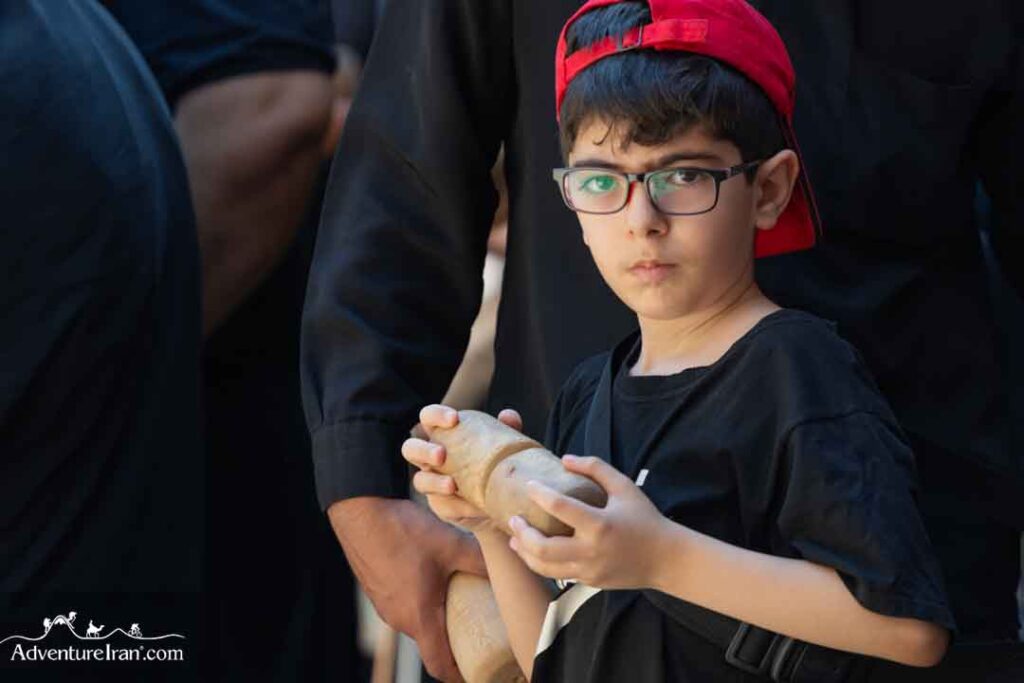
One of the most distinctive ceremonies of Tasua in Abyaneh is Jaghjagheh-zani. Participants carry small wooden clappers called jaghjagheh and strike them together rhythmically while moving through the narrow streets of the village. The sound is sharp and repetitive. It echoes between the old red walls and mixes with mourning chants, drums, and cymbals.
The procession moves from one part of the village to another, and families who have lost relatives during the previous year may receive the mourners outside their homes. These families may distribute food or other forms of nazr, a religious offering made as an act of devotion. This gives the ceremony a deeply personal dimension.
The mourning is not only for Imam Hussein and the tragedy of Karbala. It also becomes an occasion for the community to remember its own dead. Jaghjagheh-zani, together with Nakhl-gardani in Abyaneh, has been registered as part of Iran’s national intangible cultural heritage.
Nakhl-Gardani: Carrying the Symbol of Mourning
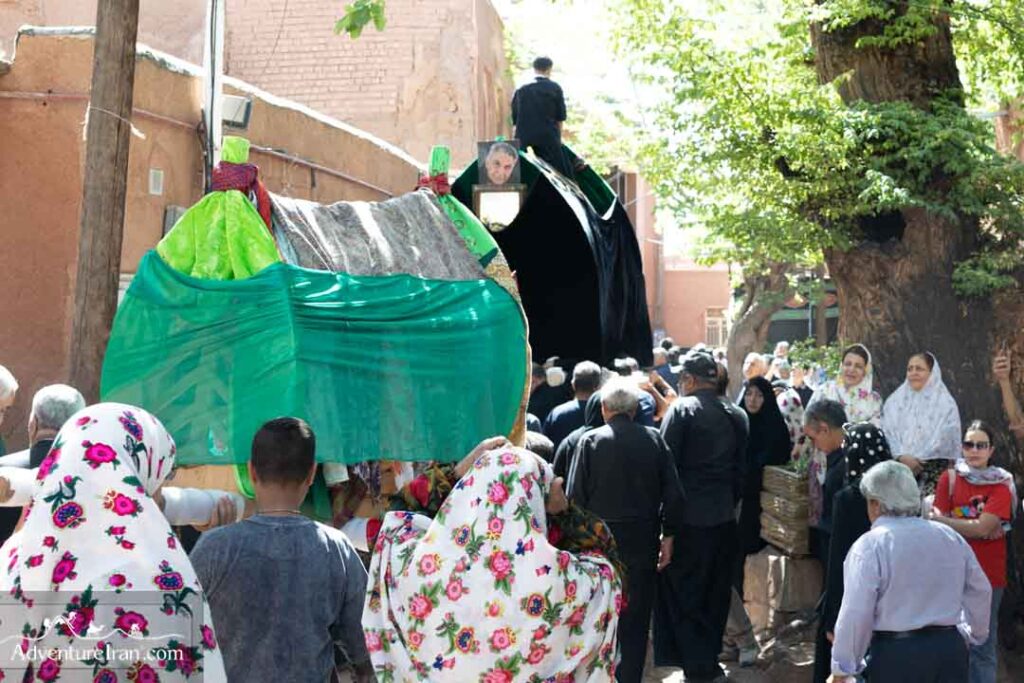
Perhaps the most powerful and visually striking ceremony of Tasua is Nakhl-gardani. The word nakhl literally means “palm,” but in this context it refers to a large wooden ceremonial structure traditionally understood to symbolize the bier or coffin of Imam Hussein. Nakhl-gardani is practiced in several parts of central Iran, including Yazd, Kashan, Na’in, Ardestan, and Abyaneh. Each region has its own version of the ritual.
In Abyaneh, the ceremony is especially dramatic because of the village’s steep streets and mountainous surroundings.
The village traditionally has two nakhls associated with different neighborhoods. Before the ceremony, the structure is decorated with black cloth, traditional textiles, and other ornaments. Then groups of men lift the heavy wooden structure onto their shoulders.
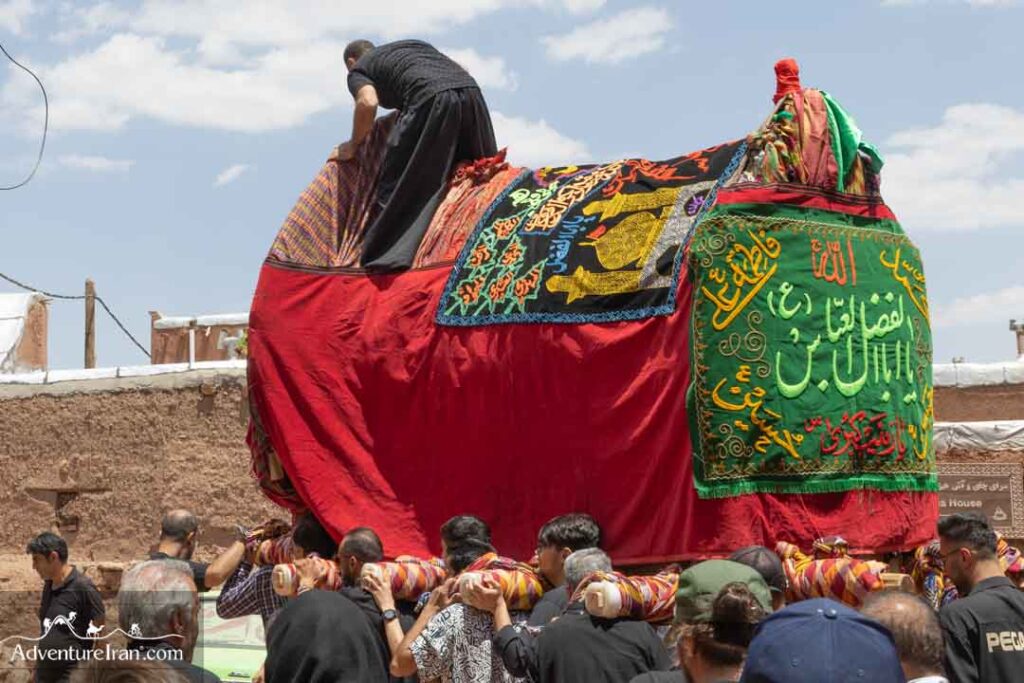
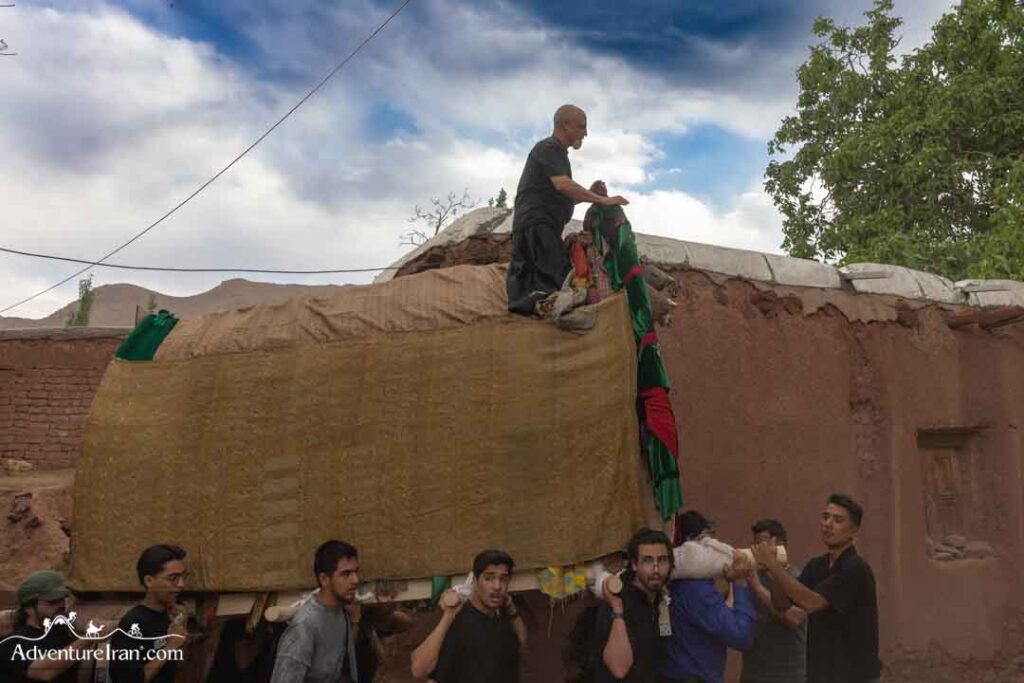
Carrying the nakhl through Abyaneh is physically demanding. The streets are narrow, steep, and uneven, and the procession must carefully pass through the old village. Traditionally, one person sits on the nakhl and helps guide those carrying it, especially when the structure passes through narrow sections.
Eventually, the procession reaches the area around Cheshmeh-ye Chama, where the mourners rest and pray and food is distributed as a religious offering. One of the most dramatic moments comes when the nakhl associated with the Har-deh neighborhood is carried up the steep mountain slope. The large wooden structure slowly moves upward, carried by a group of mourners, while voices calling “Ya Hussein” rise through the mountains. For a documentary photographer, the scene is extraordinary.
The red walls, black clothing, traditional garments, wooden structure, mountains, movement, and collective effort create a powerful visual landscape. But the real meaning of the scene lies beyond its visual beauty.
It is a religious ritual carried by the community.
Parsa or Porseh: Remembering the Dead
Another Tasua tradition in Abyaneh is known as Parsa or Porseh.
Men from the Har-deh neighborhood gather and move through the village, visiting the homes of families who have lost a loved one during the previous year. At each house, the family may offer food to the mourners. The visitors offer condolences and prayers for the deceased.
The ceremony creates a connection between the tragedy of Karbala and the personal losses of the community. In Abyaneh, remembering the dead is therefore not limited to the historical events of fourteen centuries ago. The village also remembers its own people.
Shada-Gardani
Another lesser-known tradition associated with Tasua is Shada-gardani, sometimes called Shada-bardari. A shada is a tall wooden pole decorated with textiles. Members of families traditionally connected with the ceremony carry the shada through the village. Scarves, shawls, silk fabrics, and other textiles may be attached to it as religious offerings.
Like many of Abyaneh’s Muharram traditions, Shada-gardani is closely connected with the village’s old neighborhoods and family relationships. Some responsibilities associated with the ritual have traditionally been passed from one generation to another.
This is what makes the Muharram ceremonies of Abyaneh particularly interesting. They are not simply religious events taking place in a historic setting. They are part of the village’s social fabric.
Ashura Morning: Tolu-Khani
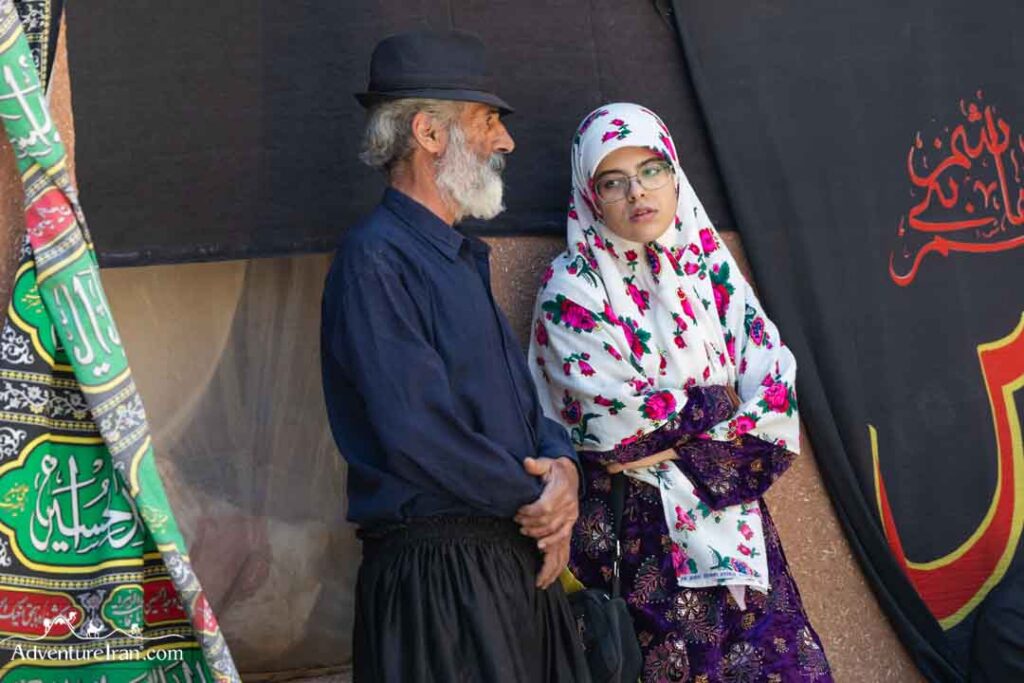
The ceremonies continue into the morning of Ashura. Before sunrise, Abyaneh traditionally holds Tolu-khani, a mourning ceremony in which verses and lamentations recount the tragedy of Karbala. The ceremony continues until sunrise, after which participants proceed toward the Hosseiniyeh for morning prayer.
Unlike some of the public ceremonies, Tolu-khani has traditionally been regarded as a more private gathering. Visitors have not traditionally been permitted to attend. This distinction is important for anyone visiting Abyaneh during Muharram. Not every ceremony is intended for tourists.
Some traditions belong entirely to the local community, and respecting those boundaries is an essential part of responsible cultural travel.
Ashura and the Nakhl Procession
After the early morning ceremonies, the village prepares for another procession. The nakhl is once again carried through the narrow streets of Abyaneh, accompanied by mourning groups. When the procession reaches the homes of families who have recently lost a loved one, it may stop while the family distributes food to the mourners.
One traditional offering associated with Ashura in Abyaneh is nan-e zard, a local yellow-colored bread or food offering. Eventually, the procession reaches Cheshmeh-ye Chama, where the community gathers for the noon prayer.
Later, the nakhl is returned to its traditional place in the village.
Sham-e Ghariban: The Night of Ashura
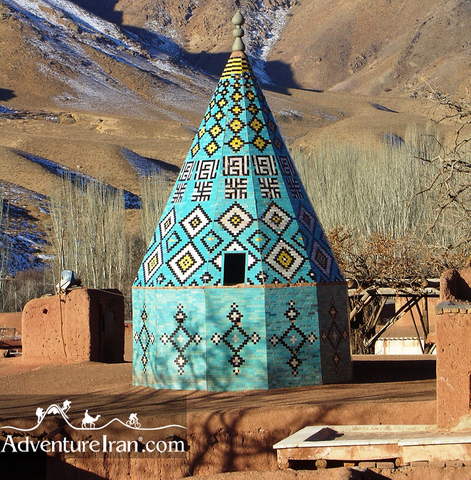
After sunset, the atmosphere changes once again. The powerful processions of the day give way to a quieter ceremony known as Sham-e Ghariban, meaning the “Night of the Strangers.” Groups of young men traditionally gather near Yosmon Mosque and move through several neighborhoods while reciting traditional mourning poems. The procession eventually reaches the shrines of Shahzadeh Isa and Shahzadeh Yahya before returning to the mosque.
At night, the red walls of Abyaneh disappear into darkness. The voices of the mourners become more prominent, and the atmosphere becomes quieter and more contemplative. After the energy of the daytime ceremonies, Sham-e Ghariban brings Muharram to a deeply emotional close.
A Tradition That Belongs to the Community
What makes Muharram in Abyaneh important is not simply the age of its ceremonies or their visual beauty. It is the connection between the rituals and the people who preserve them. Abyaneh‘s traditional architecture, clothing, language, customs, and religious ceremonies have all contributed to the village’s identity. Some cultural accounts also suggest that certain Iranian mourning traditions may have connections with older Iranian forms of lamentation.
These interpretations are interesting, but they should be treated carefully. Such connections are not established historical facts. What can be said with confidence is that the Muharram ceremonies practiced in Abyaneh today are an important part of the village’s living cultural heritage. They have been shaped by generations of religious belief, local customs, family relationships, and community memory.

Visiting Abyaneh During Tasua and Ashura
Visiting Abyaneh during Muharram is very different from visiting the village at other times of the year. During Tasua and Ashura, many people whose families originated in Abyaneh return to the village. As a result, the population can increase considerably. The village itself has limited space and infrastructure, and access may be restricted during the main ceremonies. For this reason, travelers should not assume that normal tourist access will be available during Tasua and Ashura. It is important to check current access regulations and make arrangements in advance.
Abyaneh is located in Isfahan Province, near Natanz and the Karkas Mountains, at an elevation of approximately 2,200 meters. It is around 70 kilometers southeast of Kashan and approximately 40 kilometers from Natanz. For international travelers, arranging transportation and accommodation in advance is strongly recommended, especially during the busy days of Muharram.
Photography During Muharram in Abyaneh
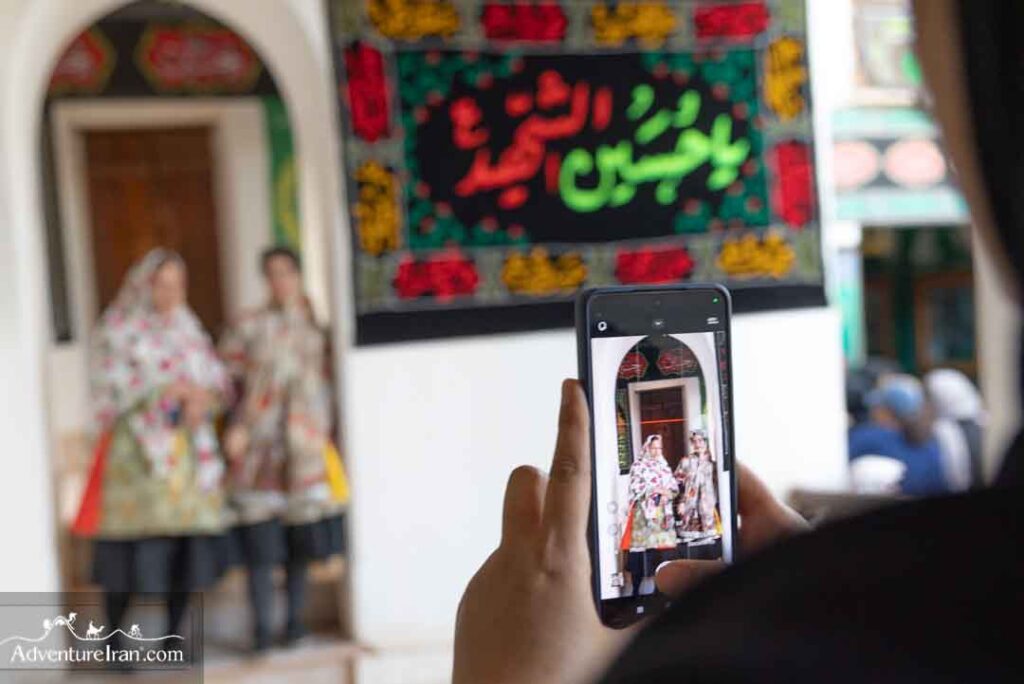
For documentary photographers, Tasua and Ashura in Abyaneh offer extraordinary visual possibilities. But these are religious ceremonies, not cultural performances arranged for visitors. Photography should therefore begin with respect. Ask permission before photographing individuals, particularly grieving families. Do not interrupt a procession or step into the path of the nakhl. Avoid using flash if it may disturb the ceremony, and follow any instructions given by local residents or organizers.
The strongest documentary photographs often come from observation rather than intrusion. The red walls of Abyaneh, black mourning clothes, traditional village clothing, wooden structures, mountain slopes, and moving crowds naturally create a powerful visual environment. But the real story is not simply the unusual appearance of the scene.
It is the people.
It is their memory.
It is their faith.
And it is the relationship between the ritual and the community that has carried it from one generation to another.
Experiencing Living Heritage in Iran
Iranian cultural heritage is not limited to archaeological sites, ancient ruins, palaces, and museums. In places such as Abyaneh, heritage is still practiced. It can be heard in the sound of wooden clappers echoing through a narrow alley. It can be seen in a family preparing food as a religious offering. It can be felt in the collective effort of dozens of people carrying a nakhl up a steep mountain slope. And it can be understood in the quiet moments when families gather to remember those they have lost.
For travelers who want to understand Iran beyond its famous monuments, experiencing Tasua and Ashura in Abyaneh offers a remarkable window into the country’s living traditions.
Here, history is not behind glass.
It walks through the streets.
It is carried on people’s shoulders.
It is remembered through voices, movement, prayer, and community.
And for a few days each year, the red village of Abyaneh becomes a place where faith, memory, family, and history move together.
Plan Your Visit to Abyaneh
Abyaneh can be included in an Iran cultural itinerary connecting Kashan, Abyaneh, and Isfahan. However, visiting during Tasua and Ashura requires special planning because access, accommodation, transportation, and participation in some ceremonies may be different from an ordinary visit.
If you are planning to experience Muharram in Abyaneh, it is best to arrange your visit well in advance and check the latest local regulations. For more information about Abyaneh and travel planning in Iran, see the Adventure Iran guide to Abyaneh Historical Village.
Frequently Asked Questions
What is Muharram?
Muharram is the first month of the Islamic lunar calendar. For Shia Muslims, it is especially important as a month of mourning for Imam Hussein and his companions, who were killed at the Battle of Karbala in 680 CE.
What are Tasua and Ashura?
Tasua is the ninth day of Muharram and Ashura is the tenth day. They are among the most important days of mourning for Shia Muslims. Ashura commemorates the death of Imam Hussein and his companions at Karbala.
When are Tasua and Ashura celebrated?
Because Muharram follows the Islamic lunar calendar, Tasua and Ashura fall on different dates in the Gregorian calendar each year.
What is Jaghjagheh-zani in Abyaneh?
Jaghjagheh-zani is a traditional mourning ceremony in which participants carry small wooden clappers called jaghjagheh and strike them together rhythmically while moving through the village and reciting mourning chants.
What is Nakhl-gardani?
Nakhl-gardani is a Muharram ritual in which mourners carry a large wooden ceremonial structure known as a nakhl. It traditionally symbolizes the bier or coffin of Imam Hussein.
Is Abyaneh open to tourists during Tasua and Ashura?
Access may be restricted during the main ceremonies because of large crowds, limited village infrastructure, and the need to protect the privacy and religious character of the rituals. Travelers should check the latest regulations before planning their visit.
Can photographers photograph the ceremonies?
Photography may be possible, but visitors should respect the religious nature of the ceremonies. Always ask permission before photographing people, particularly grieving families, and follow the instructions of local residents and ceremony organizers.
Where is Abyaneh?
Abyaneh is a historic mountain village in Isfahan Province, near Natanz and the Karkas Mountains. It is approximately 70 kilometers southeast of Kashan and around 40 kilometers from Natanz.
Why is Abyaneh important?
Abyaneh is important for its historic architecture and for preserving traditional elements of Iranian culture, including local clothing, language, customs, and religious ceremonies. Its Muharram traditions are an important part of its living cultural heritage.
Comments