Tous, Siraf & Persian Mosques Three New UNESCO World Heritage Candidates in Iran Three New UNESCO World Heritage Candidates in Iran: Tous, Siraf and the Persian Mosques Iran’s UNESCO World Heritage story is entering a new chapter. Following the inscription of Alamut Castle and its Related Fortifications on the UNESCO World Heritage List in July 2026, Iran now has 30 UNESCO World Heritage properties. At the same time, Iran is preparing several new nominations for possible future inscription. Among the most important are the historic city of Tous in Khorasan Razavi Province, the ancient port of Siraf on the Persian Gulf, and a serial nomination representing some of Iran’s most important historic mosques. These three candidates tell very different stories. Tous represents the cultural and literary heritage of Khorasan and the legacy of the great Persian poet Ferdowsi. Siraf recalls the extraordinary maritime trade that once connected Iran with India, China, East Africa and the wider Indian Ocean world. The Persian Mosque nomination, meanwhile, aims to demonstrate the long development of Iranian Islamic architecture across different historical periods and regions. For travelers interested in Iran’s history, culture, architecture and lesser-known heritage sites, these three places are especially worth watching. Iran Now Has 30 UNESCO World Heritage Sites. On July 26, 2026, Alamut Castle and its Related Fortifications were officially inscribed on the UNESCO World Heritage List during the 48th session of the World Heritage Committee in Busan, South Korea. The inscription includes not only the famous Alamut Castle but also a network of seven medieval fortifications spread through the rugged Alamut region of Qazvin Province. With this inscription, Iran’s number of World Heritage properties reached 30. UNESCO currently lists 28 cultural and two natural World Heritage properties for Iran. Iran also has a much larger group of places on
Tous, Siraf & Persian Mosques Three New UNESCO World Heritage Candidates in Iran Three New UNESCO World Heritage Candidates in Iran: Tous, Siraf and the Persian Mosques Iran’s UNESCO World Heritage story is entering a new chapter. Following the inscription of Alamut Castle and its Related Fortifications on the UNESCO World Heritage List in July
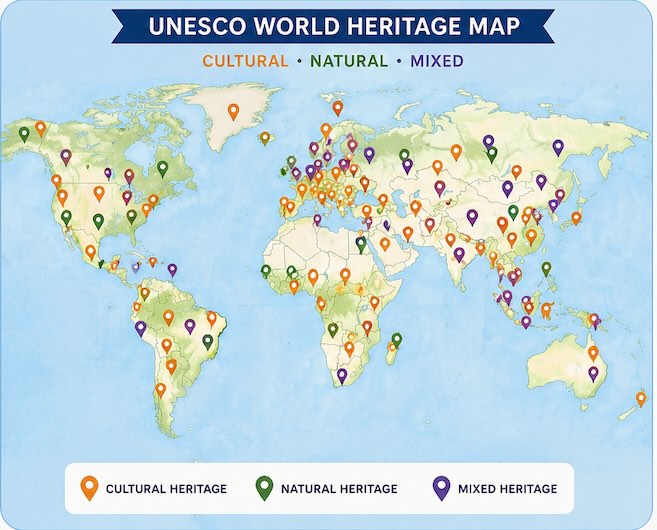
UNESCO’s New 2025–2026 World Heritage Map Now Features Iran’s Khorramabad Valley UNESCO’s Latest World Heritage Map Includes Iran’s Newest Treasure UNESCO has unveiled its 2025–2026 World Heritage Map, showcasing every property currently inscribed on the World Heritage List. For the first time, the Prehistoric Sites of the Khorramabad Valley appear on UNESCO’s official global map, marking another important milestone for one of the world’s most significant archaeological landscapes. Although the Khorramabad Valley was inscribed on the UNESCO World Heritage List in 2025, its inclusion on the newly published map gives the site even greater international visibility. Used by travelers, researchers, educators, and heritage enthusiasts worldwide, the UNESCO World Heritage Map is far more than a simple geographic reference—it is a visual guide to humanity’s most exceptional cultural and natural treasures. For Iran, the addition of the Khorramabad Valley represents another proud moment. The country now boasts 30 UNESCO World Heritage Sites, highlighting its extraordinary contribution to the story of human civilization. What Is the UNESCO World Heritage Map? Every few years, UNESCO publishes an updated World Heritage Map reflecting the current list of recognized cultural and natural properties across the globe. The map is designed to help travelers, students, historians, and governments explore the distribution of World Heritage Sites while raising awareness about their protection. Every new inscription is eventually added to this official map, making it one of the most authoritative visual references for global heritage. The publication of the 2025–2026 edition is particularly significant for Iran because it introduces the Prehistoric Sites of the Khorramabad Valley to millions of people who use UNESCO’s educational materials and travel resources. Where Is the Khorramabad Valley? The Khorramabad Valley lies in Lorestan Province in western Iran, surrounded by the spectacular Zagros Mountains. For thousands of years, these mountains
UNESCO’s New 2025–2026 World Heritage Map Now Features Iran’s Khorramabad Valley UNESCO’s Latest World Heritage Map Includes Iran’s Newest Treasure UNESCO has unveiled its 2025–2026 World Heritage Map, showcasing every property currently inscribed on the World Heritage List. For the first time, the Prehistoric Sites of the Khorramabad Valley appear on UNESCO’s official global